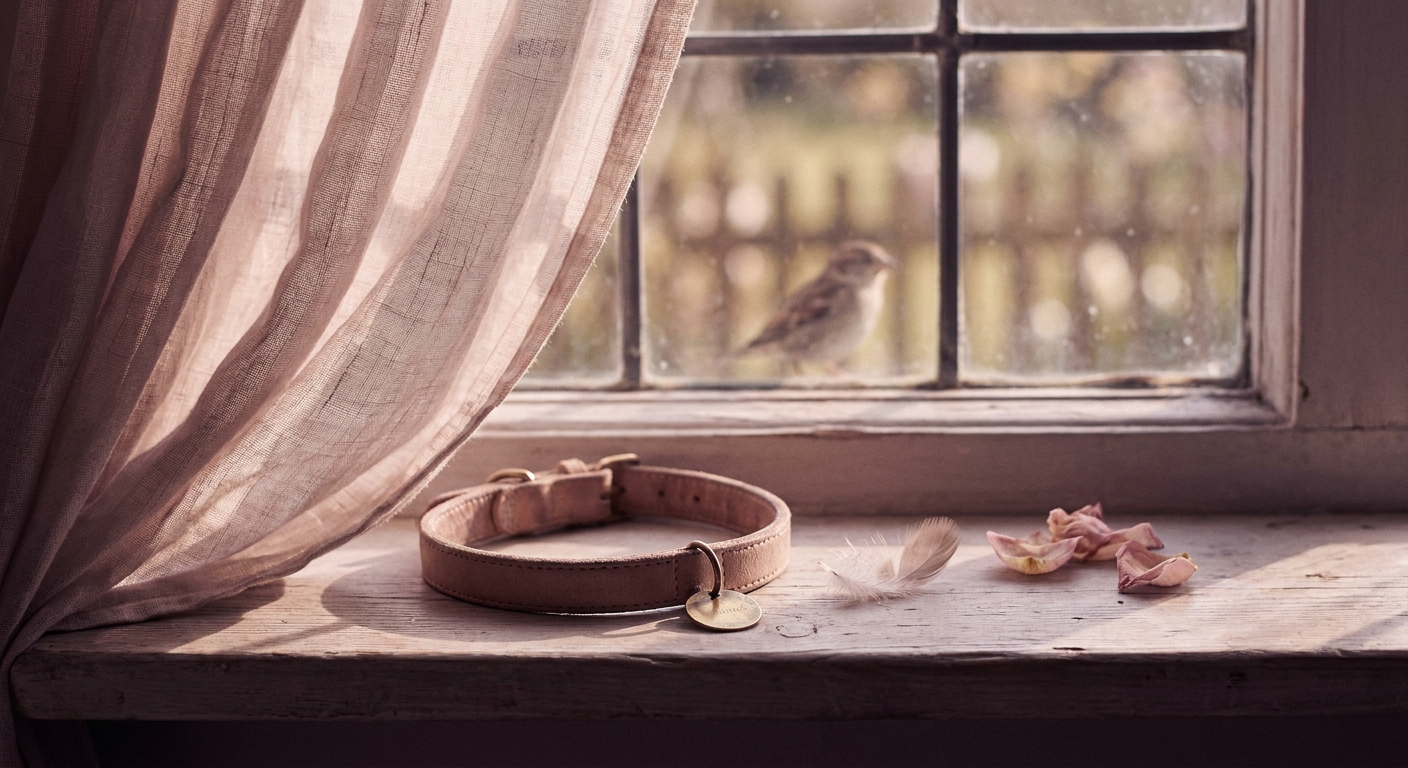
If you have felt your pet nearby since they died, you are not losing your grip in the way people quietly fear they might be. Many grieving owners notice the same small things: a dream where their pet is well again, the sound of a collar or paws in an empty house, a sudden warmth or the sense of a presence in a familiar spot, a cardinal or butterfly that stays a beat too long, or a scent that drifts through a room and is gone. No one can prove these are visits, and a heart that loved this deeply will keep noticing the one it misses. Whether you read them as signs or as love finding a quiet way to reach you, it is okay to be comforted.
This is a gentle look at the signs people report, why a grieving mind tends to notice them, and what you might do with the feeling when it comes.
What are the most common signs a deceased pet is visiting you?
The signs people describe tend to fall into a few familiar shapes. You may recognize more than one.
Dreams. This is one of the most common, and often the most tender. Your pet appears whole and happy, sometimes younger than they were at the end, and the dream feels unusually vivid. People frequently wake calmer than they went to sleep, as if they were allowed one more quiet moment together.
A sense of presence. A feeling that your pet is in the room, curled in their old spot or padding down the hall. Some people catch a flicker of movement at the edge of their vision and turn, half expecting to see them.
Familiar sounds. The jingle of a collar, nails on the floor, a soft sigh, a bark from another room. In a house that has gone quiet, these sounds can arrive with startling clarity.
Touch and warmth. The light brush of fur against a leg, a warm spot on the bed or the couch, the weight of a pet who used to lean into you. These small physical echoes can catch you off guard on an ordinary afternoon.
Their scent. The smell of their fur or their bed drifting past for a moment. Scent is tied closely to memory, which may be why it can feel so much like them.
Animals that seem to visit. A cardinal that lingers on the fence, a butterfly or dragonfly that comes close and stays, a bird that turns up at a meaningful moment. Many people take these as a hello. What matters is not whether the animal carries a message, but the tenderness you feel when you notice it.
Small found objects and oddities. A feather on the doorstep, a coin, a favorite toy that turns up when you needed it. Some people notice lights flickering, or repeating numbers, or a song that arrives at the right moment. These are the kinds of things a grieving mind holds onto, and there is nothing wrong with holding on.
Waves of feeling. A sudden, unexplained warmth or a swell of love, often around an anniversary or a quiet evening. Grief and love share the same root, and sometimes they surface together.
You do not have to have experienced all of these, or any particular one, for your grief to be real or your bond to have been strong.
Why do grieving pet owners notice these signs?
There are two honest answers, and they do not cancel each other out.
The first is about how a loving mind works. When you have spent years attuned to a specific animal, listening for their feet on the stairs, feeling for them beside you at night, your senses stay tuned to them long after they are gone. So a house settling, a trick of light, a passing bird, or a dream can land on that raised awareness and feel like them. This is not a flaw or a delusion. It is the shape love leaves behind.
The second is about grief itself. For a long time people were told that healthy grieving meant letting go and severing the connection. Grief researchers Dennis Klass, Phyllis Silverman, and Steven Nickman challenged that idea in their 1996 work on what they called continuing bonds. They found that keeping an ongoing, changed relationship with the one you lost is normal, healthy, and often comforting, rather than something that holds you back. Watching for signs, talking to an empty room, feeling your pet close, all of it is a way of staying connected. By that understanding, noticing signs is not a symptom to worry about. It is love continuing in a new form.
You can hold both answers at once. The comfort does not depend on choosing.
Is it real, or am I making it up?
This is the question people search for late at night, and often feel a little ashamed to ask. Here is a kinder way to sit with it.
You do not have to settle whether a sign came from beyond or came from your own longing for it to matter. A warm feeling that your pet is near is real in the sense that counts: it happened to you, and it brought you comfort. People keep a collar on a shelf, carry a photo in a wallet, and talk to a spot on the couch, and none of that is foolish. If a cardinal on the fence loosens the tightness in your chest for a moment, the cardinal did something kind for you, whatever else is true.
Doubt and belief can live side by side. You are allowed to take as much comfort as a sign offers without needing to prove where it came from, and you are allowed to be unsure. Grief does not ask you to have it figured out.
What can you do when you notice a sign?
There is no ritual you are required to perform. When something arrives that feels like your pet, you might simply pause and let it land. A few gentle options:
Say hello. Out loud or in your head, tell them you noticed, or say the thing you wish you had said. Many people find this steadying.
Write it down. A short note about the dream, the cardinal, the warm spot, kept in your phone or a notebook. Over time these small entries become a quiet record of a bond that did not end.
Let it be enough. You do not need to chase a sign or test it or wait anxiously for the next one. Signs seem to come most easily when you are not gripping for them. If one comes, receive it. If it does not, that is all right too.
What if you haven't received a sign from your pet?
If you have been watching and nothing has come, please know this: the absence of a sign is not a message. It does not mean your pet was not bonded to you, and it does not mean they are not at peace.
In the early weeks especially, grief can be so heavy and numbing that there is little room left to notice anything gentle. Some people are simply less prone to reading meaning into a dream or a bird, and that is a difference in temperament, not in love. And sometimes the quiet is just quiet.
You can also make your own moment of connection rather than wait for one. Sit somewhere you both loved. Look at photos and say their name. Light a candle on an evening that feels hard. Take the walk you used to take together. Reaching toward them on purpose is every bit as real as a sign that arrives on its own, and it is something you can offer yourself whenever the missing grows loud.
A quiet way to keep them close
However the signs come, or if they do not, the bond you are feeling is worth tending. Some people plant something. Some keep a tag on a keychain or frame a favorite photo. Others like having something they can actually hold, a keepsake that keeps a shape in the world, so that keeping their pet close does not depend only on catching a sign. If that would help you, it can be a gentle step whenever you feel ready, and never before.
For more on the comforting picture many owners hold onto, you might read our gentle explanation of what the Rainbow Bridge means for pets. Take your time. The love that makes you watch for them is not going anywhere.