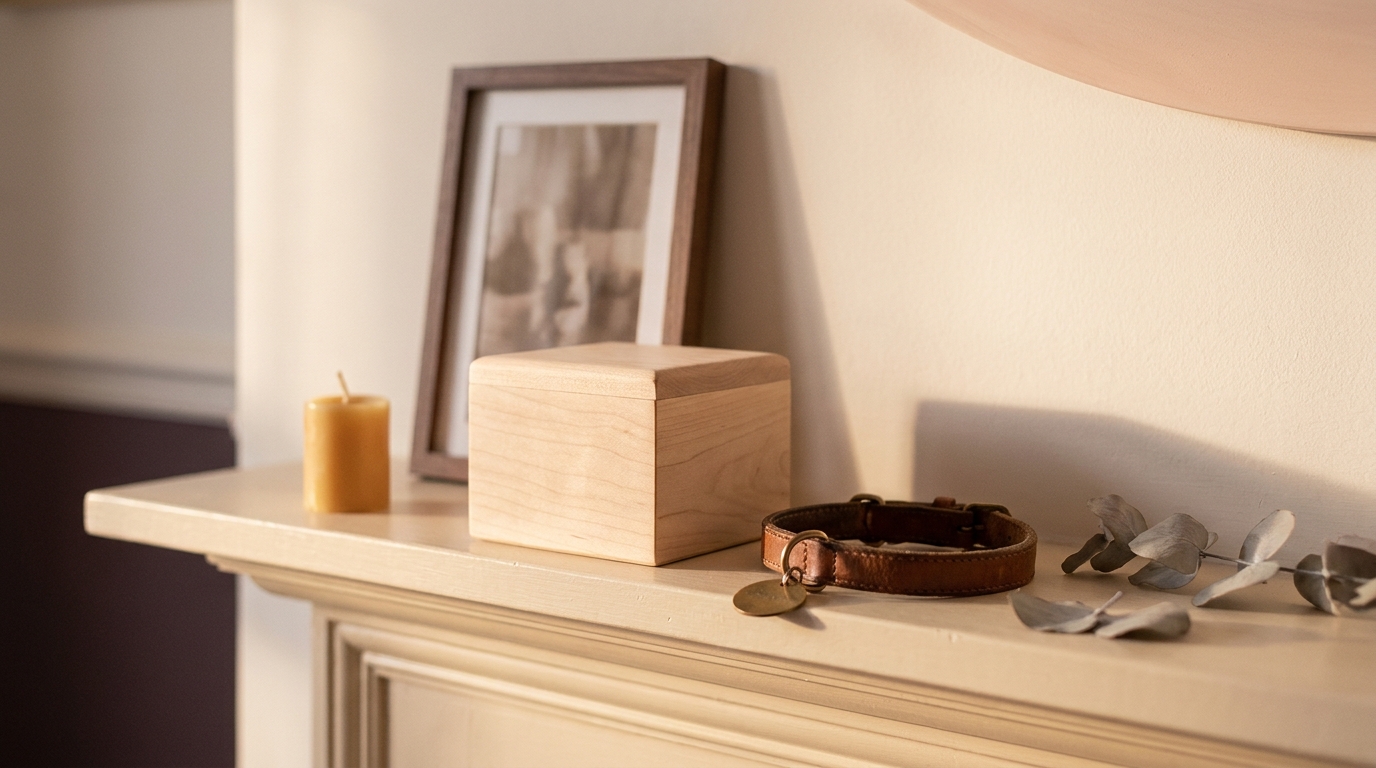
When your pet's ashes come home, they can sit heavier in your hands than you expected. There is no wrong thing to do with them, and there is no clock running. Most people keep them in an urn at home, scatter or bury them somewhere that mattered, or turn a small amount into something they can hold, and plenty of people wait months or years before deciding anything at all. This is a gentle guide to those choices, grouped by what you might need right now, so you can pick the one that feels most like them.
Is it okay to keep your pet's ashes for a long time?
Yes. You can keep them for as long as you want, including forever. Cremated ashes are stable and safe to have at home, so there is no health reason and no rule pushing you to do anything at all.
Many people keep an urn on a shelf, a mantel, or a bedside table and never move it anywhere else, and that is a complete and loving choice on its own. If having them close is what helps you feel your companion is still near, then keeping them is not a decision you are avoiding. It is the decision. You can always choose something else later, and you can also choose nothing else, ever.
What are the main things people do with a pet's ashes?
It helps to think less about the long list of options and more about what you need from them right now. Most choices fall into one of four gentle groups.
If you want to keep them close, an urn is the most common path, and it can be as plain or as personal as you like. Some people choose a simple wooden or ceramic box, others an engraved urn with their pet's name and dates, and others a photo urn or a small figurine urn that holds a little of their character. A tiny portion can also go into a glass keepsake, a pendant, or a memory vial kept beside their collar and tag.
If you feel ready to let them go, scattering or burying can bring a sense of release. People scatter in a backyard, a favorite walking spot, or a garden, and some bury the ashes in a biodegradable or living urn that grows into a tree or a plant you can tend through the seasons. A small memorial stone or a planted patch of their favorite flowers can mark the place so you always know where to go.
If you want to share them among family, you do not have to choose one home. Ashes can be divided into several small keepsakes so that everyone who loved your pet can keep a part of them, whether that is a sibling in another city or a child who is grieving too.
And if you are not ready for any of that, you can hold and wait. Keeping the ashes exactly as they are, unopened and safe, is a real choice and often the wisest one in the early days. You can revisit it whenever, or never. Nothing is lost by waiting.
Where are you allowed to scatter pet ashes?
Scattering feels simple, but a few places have rules, and it is kinder to yourself to know them before rather than after. The short version is that your own land is fine, other people's land needs a yes, and public land often has conditions.
On your own property you can scatter or bury ashes freely. On someone else's land, including a friend's field or a private woodland your pet loved, you need the owner's permission first. Public parks and beaches vary widely by town and state, so a quick call to whoever manages the land saves you worry later.
National parks are stricter than most people expect. Scattering cremated remains there requires a permit, and the federal rule behind it is written around human ashes, so a park may not allow a pet at all. Contact that specific park before you plan anything.
Water has its own rule that is easy to get wrong. The familiar guidance that you may scatter cremated remains at least three nautical miles from shore comes from a federal permit that covers human remains only, and it plainly states that pet ashes are not included. For a pet, check your state and local rules instead, and if you do scatter over water, use no plastic, only a container that breaks down quickly and gently.
Can you turn your pet's ashes into something you keep?
Yes, and for many people this is the most comforting path of all, because it keeps a piece of their companion in a form they can hold or wear. A small amount of ash is all most of these take, which means you can keep the rest however you like.
Ashes can be set into jewelry, such as a pendant, ring, or bracelet you carry with you. Glass artists can blend a little into a handmade orb or a smooth touchstone that catches the light. There are studios that press ashes into a memorial stone, work them into a painting or a piece of pottery, or even turn the carbon in them into a small created gem. Each of these lets you keep something tactile and personal without having to part with all of the ashes at once.
You do not have to pick only one. It is common to keep most of the ashes in an urn, set a little into a piece of jewelry, and scatter a small amount somewhere you both loved. Splitting them this way is not indecision. It is letting different parts of your grief have what each of them needs.
How do you decide when you feel stuck?
Feeling frozen in front of the urn is ordinary, and it does not mean you are doing this wrong. When the list of options feels like too much, it can help to set the options aside and ask yourself one quieter question: what do I need right now?
If what you need is closeness, keep them near you and let that be enough. If you need a sense of release, scattering or planting can give grief somewhere to move. If you are carrying this with other people, sharing the ashes can hold you all together. And if what you need most is time, then time is the answer, and the ashes will wait for you as long as you need.
Some people have ashes from more than one companion and feel unsure how to honor them all. You can keep them together in a shared urn or a memorial spot, or give each their own small keepsake. There is no hierarchy of love here and no wrong arrangement. Whatever lets you feel all of them close is the right one.
A gentle next step
You do not have to settle any of this today, and you do not have to settle all of it ever. A choice made in six months is no less loving than one made this week, and keeping the ashes just as they are is itself a way of holding on.
When you feel ready to think about keeping your companion close in other ways, you might read our gentle guide to preserving a pet's memory or our ideas for meaningful pet memorial gifts. Some people find comfort in a keepsake that holds their pet's actual likeness, a small figurine shaped from a favorite photo, kept on the shelf beside the urn so the ashes and their face rest together. If that would help whenever you are ready, it can be a soft next step, and there is no hurry at all. However you choose to keep them, the love that makes this hard is the same love that will carry you.