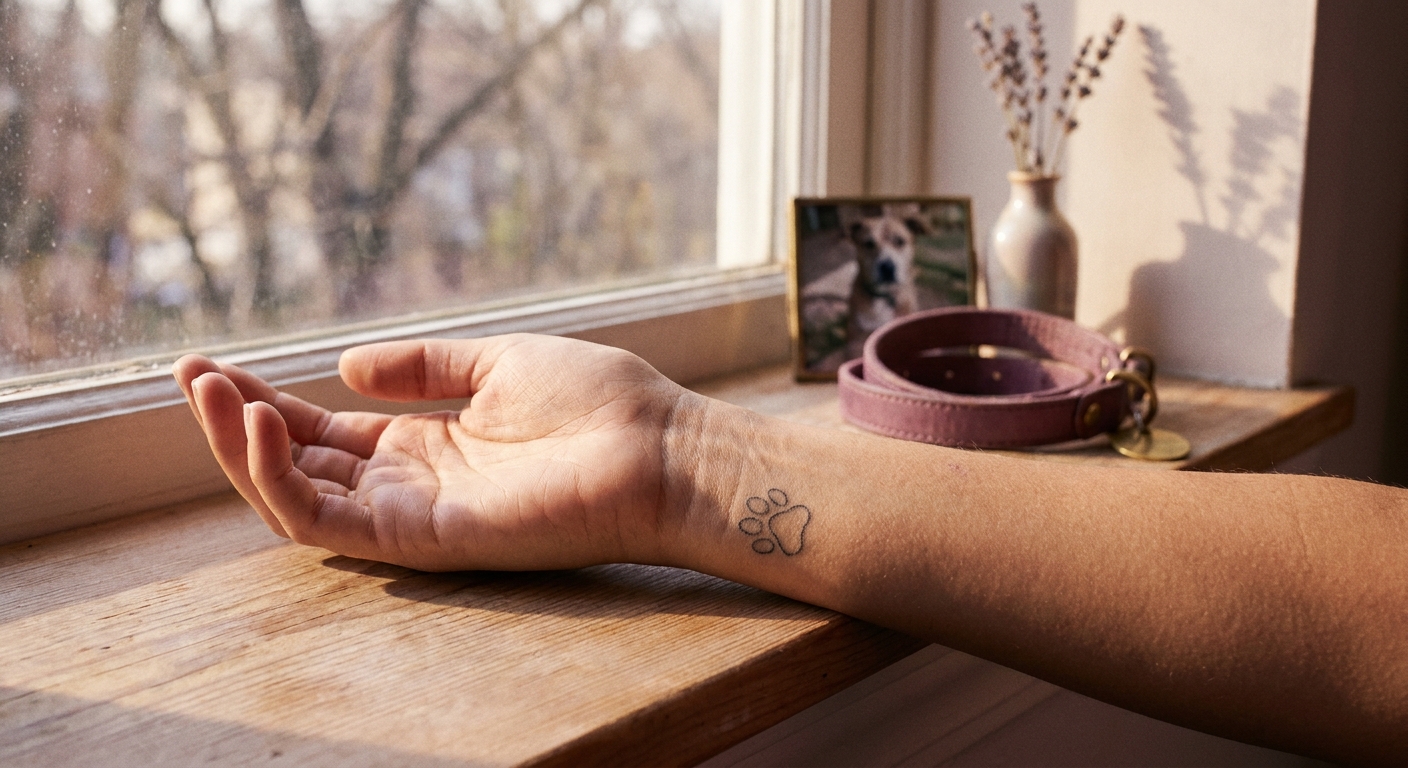
If you are weighing a tattoo to remember a pet, the short version is that almost every design people choose comes down to a handful of ideas: a paw outline, a portrait, a name with the dates you shared, a silhouette, a small rainbow bridge scene, or a heartbeat line that carries one of those shapes inside it. None of them is more "correct" than another. The one worth getting is the one you will still want to see on your own skin in ten years, not just the one that feels right this week.
What are the most common pet memorial tattoo ideas?
A paw outline is the design people come back to most, because it is simple, recognizable at a glance, and works at almost any size, from a coin-sized mark on the wrist to a larger one that leaves room for a name underneath.
A portrait asks more of both you and the artist. Done well, it captures your pet's actual face or a specific expression, but it needs a skilled artist who has real experience with animal portraits and several clear, well-lit reference photos. This is the design most likely to disappoint if the artist is not a genuine specialist in it, so look at their healed portrait work, not just their sketches, before you book.
A name and the dates you had together is the plainest option, and often the most enduring one. A first name, sometimes a nickname only you used, with a birth year and the year they died, kept small and legible.
A silhouette captures how your pet actually stood or sat, the particular tilt of their head or the way their ears sat, without needing the detail a full portrait requires. It reads well even quite small, which makes it a good choice for a first tattoo or a private placement.
A small rainbow bridge scene leans into the imagery many grieving pet owners already find comforting, sometimes just a simple arc, sometimes with clouds or a single star. It suits people who want something a little more visual than text alone without going as detailed as a portrait.
A heartbeat line that flattens into a tiny paw, heart, or silhouette partway through is a newer idea, and a quiet way to say this pet mattered to how your heart beats without naming them outright.
A short, meaningful word works too. Something like their name alone, or a single word that was theirs, like a nickname you called them or what you called their favorite game, placed simply with no other imagery.
Where should you place a pet memorial tattoo?
This comes down to whether you want to see it often or keep it mostly to yourself, and both are completely fine.
The wrist, forearm, inner arm, and ankle are the most chosen spots for anyone who wants the tattoo to catch their own eye during an ordinary day, a small private moment built into places you already look. The ribs, upper arm, shoulder blade, and thigh suit people who want something that is there for them and only shown to others on their own terms.
Size follows from the design more than the design follows from the placement. A simple outline or a few words can sit comfortably almost anywhere, even quite small. A detailed portrait needs enough real space, usually the forearm, calf, or back, to hold the detail without it blurring together as the tattoo ages.
Does getting a tattoo actually help with grief?
This is worth asking honestly before you commit to something permanent, and there is real research behind the answer, not just a feeling people repeat to each other. A qualitative study out of Smith College interviewed 14 people who had each gotten at least one memorial tattoo after losing someone, and it found the tattoos were doing real work in the grieving process. Nearly everyone described the tattoo as giving them a felt connection to who they had lost, and most said the process of getting it, not just the finished design, gave them a sense of structure during a period that otherwise felt chaotic. For several, the tattoo also became something that opened up conversations about their loss they might not have had otherwise.
That study was about people grieving people, not pets specifically, but the researchers' core finding, that a memorial tattoo works through its permanence, the ritual of getting it, and the way it invites connection rather than through the image alone, applies just as well to grieving an animal you loved. It is also a reasonable argument for not rushing the decision. If part of what helps is the ritual and the thought behind it, a design chosen carefully over time is likely to do more for you than one chosen the week grief is at its sharpest.
How do you get your pet's exact paw shape for a tattoo?
If you want a paw outline that is actually your pet's paw and not a generic clip-art shape, you have two reliable ways to get it, and it is worth asking your artist which they would rather work from before your appointment.
The first is a simple clay paw impression, made at home with a small block of air-dry or oven-bake clay pressed gently with your pet's paw, the same technique used for a keepsake impression. Photograph the dried impression from directly overhead, in flat daylight with no harsh shadow, and that photo gives an artist a true outline to trace rather than an estimate.
The second is a set of close, well-lit photos of the actual paw, taken from straight above with the paw pressed flat against a plain light background, toes relaxed and spread naturally rather than tensed. A few photos from slightly different angles give the artist options if one is blurry or the light caught a shadow wrong.
Either method beats working from a single candid photo of your pet walking, where the angle distorts the real shape of the paw more than most people expect.
How do you choose the right tattoo artist for this?
Look at an artist's healed work, not just their fresh photos or sketches, since a tattoo can look different a few weeks after it is done than it does the day it is finished. If you want a portrait, ask specifically to see portrait work, ideally of animals, since that is a different skill from lettering or simple line work even within the same artist's portfolio.
Bring your reference photos or your paw impression photo to a consultation before you book the appointment itself, and ask to see the stencil at the actual size you plan to get, on your actual skin, before the needle starts. A good artist will welcome both requests. Confirm their studio follows standard licensing and hygiene practices, which any legitimate shop will be glad to show you.
Is there a right time to get a memorial tattoo?
No, and anyone who tells you there is a deadline is wrong. Some people get a tattoo within the first week, and find the appointment itself steadying, a concrete thing to do with a feeling that otherwise has nowhere to go. Others wait months or years, until grief has settled enough that they know exactly what they want rather than reaching for the first idea that came to mind.
Because the decision is permanent, it is worth erring toward waiting if you are unsure, even by a few weeks. Double-check spelling, dates, and any translated words before the appointment. A design you chose carefully tends to age better, both on your skin and in how you feel about it, than one chosen in the sharpest days of grief.
What if you are not ready for something permanent?
That is a completely reasonable place to be, and it does not mean you care any less. A temporary or henna version of the same design is a real way to sit with an idea before committing to it permanently, and plenty of tattoo studios will do a trial version for exactly this reason.
If permanence on your own skin is not what you are looking for at all, a small sculpted keepsake made from a photo of your pet is a gentle alternative that lives on a shelf or nightstand instead, and it can hold you over for as long as you need before, or instead of, any tattoo decision. Our guide to preserving a pet's memory walks through that and several other gentle, non-permanent ways to keep them close.
A gentle next step
Whatever design you choose, or whether you choose one at all, the tattoo is never really the point. It is a way of carrying something that is already there. Take the time you need, ask the artist the questions above, and let the decision be as careful as the pet it is for deserves.
If a tattoo does not feel like the right fit but you still want something to hold, our thoughts on preserving pet memories and pet memorial gifts cover other gentle ways people choose to keep a pet close.