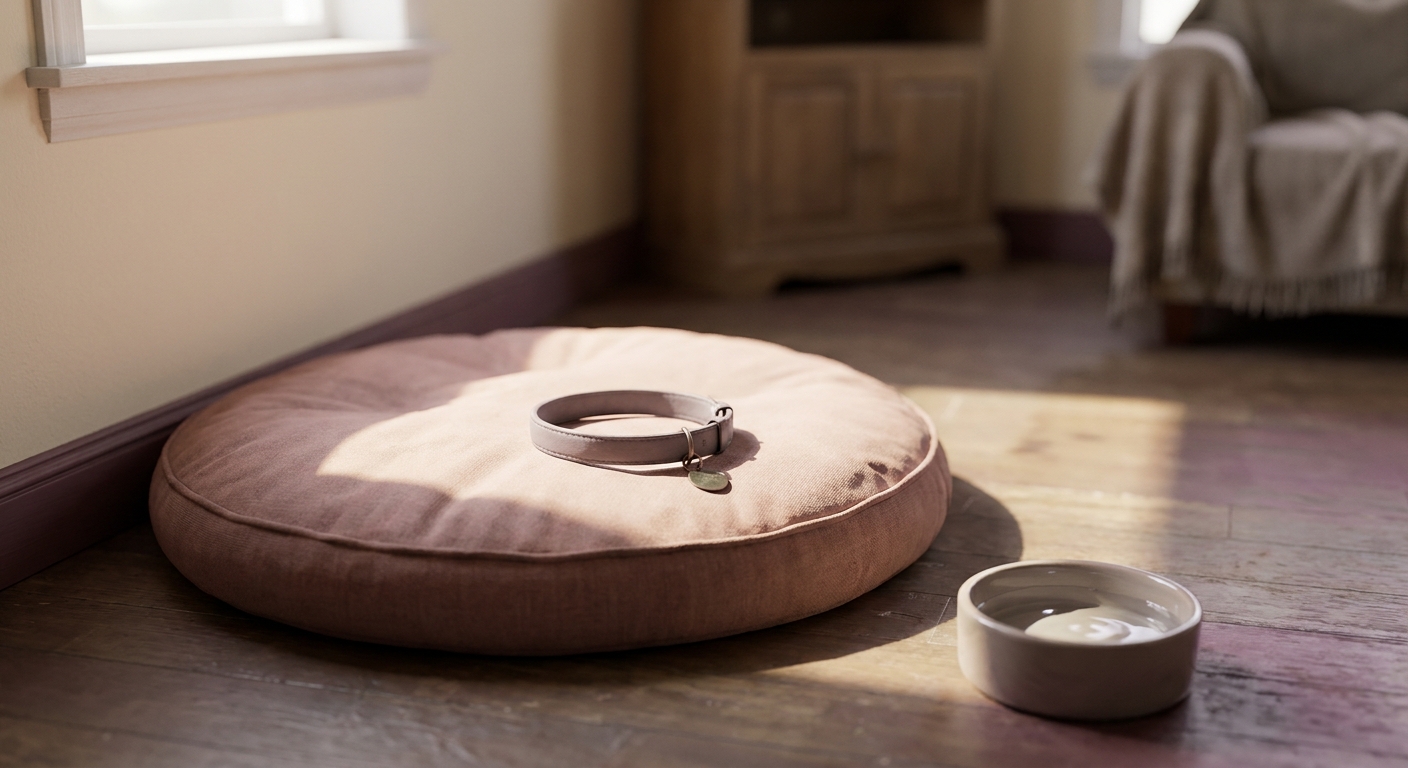
There was no warning, and now there is a quiet house. If your pet died suddenly, in an accident, a fall, or an illness that gave no time to prepare, the grief can feel sharper and stranger than you expected. That is not in your head. Researchers who study grief after pet loss point to a sudden or traumatic death as one of the things that can make mourning harder to carry, on top of everything else. What follows is why that happens, and what tends to help.
Why does losing a pet suddenly feel different from a loss you saw coming?
A death you can see coming, through age or a long illness, gives you a strange kind of gift: time. Time to say the things you want to say, to notice the last ordinary days while you still have them, to let your mind inch toward the idea of a world without your pet before it arrives. A sudden death takes all of that away at once. There is no stretch of goodbye to absorb the blow in pieces, just a before and an after with nothing in between.
That is part of why people often describe sudden pet loss as feeling more like a blow than a grief, at least at first. It is not that the love was bigger or the bond was stronger than someone who lost a pet to old age. It is that the mind had no runway. Research on pet bereavement backs this up directly: a sudden or unexpected death is named as a specific risk factor for a harder, more complicated grief, apart from how attached you were.
Is it normal to feel numb, or like it isn't real?
Yes. A lot of people expect to cry right away and are unsettled when instead they feel flat, distracted, or strangely calm. That is a real and common response to shock, not a sign that you did not love your pet enough.
Numbness after sudden news is the mind buying itself time. It can show up as going through the motions of the day on autopilot, feeling like you are watching yourself from a small distance, or simply not being able to take in that your pet is actually gone. The tears and the full ache often arrive later, once the shock has loosened its grip, sometimes hours afterward and sometimes days. Both the numb stretch and the wave that follows it are part of the same process, not two different problems.
Why do I keep replaying the moment it happened?
A long illness gives your mind a lot to sit with over time. A sudden death gives it one sharp scene, and it is common for that scene to loop. People describe going over the last moments again and again, sometimes hunting for a detail that might have changed things, sometimes just because the mind keeps returning to the one spot that still does not make sense.
This kind of replay is a known response to a sudden, shocking loss, and for most people it eases on its own over the following weeks as the rest of the grief catches up to the moment. If the images stay just as vivid and intrusive well past that point, or they are stopping you from sleeping or functioning, that is worth bringing to a counselor who works with grief or trauma specifically. Needing more support than a friend can give is not a failure. It is just what some losses call for.
What if I feel guilty I didn't catch it in time?
Guilt attaches itself to sudden loss almost automatically. You replay the morning looking for a sign you missed, a decision you would make differently now, a moment you could have acted sooner. Hindsight makes everything look obvious that was not obvious at the time. You were working with what you knew that day, not with what you know now.
This is a different kind of guilt than the kind that comes with a planned, prepared death, like choosing when to say goodbye to a pet who was already suffering. That guilt is about a decision. This guilt is usually about a thing nobody could have decided, because nobody saw it coming, including the people and vets who knew your pet well. Both are real. Neither one means you failed your pet.
What actually helps right after a sudden loss?
There is no shortcut around the shock, but a few things make it easier to carry.
Let the numbness be there without fighting it. If you cannot cry yet, or you feel oddly calm, that is not a sign you are doing grief wrong. Forcing a feeling before it is ready rarely works, and it is not required.
Say what happened out loud to someone, more than once if you need to. Telling the story of a sudden loss, even the parts that hurt to repeat, is one of the things that helps the mind stop looping on it privately. A friend, a support group, or a hotline can all serve this purpose. Cornell's Pet Loss Support Hotline, at 607-218-7457, is staffed by veterinary students trained alongside grief counselors, open evenings on weekdays and afternoons on weekends, and you do not have to give your name.
Hold off on big decisions for a few days if you can. Right after a shock is not the moment to decide what to do with a collar, a bed, or an urn. Those choices can wait until the fog thins a little.
Keep a few small routines, even ones that feel pointless now. A short walk, a regular mealtime, a bit of daylight. Shock already makes the world feel unmoored; a little structure gives you something to stand on while it passes.
When does the shock start to ease?
There is no set timeline, and anyone promising an exact number is guessing. What tends to happen, though, is that the sharpest part, the numbness, the constant replay, the jolt of disbelief, softens before the broader grief does. The shock tends to be the first layer to lift. Underneath it, the ordinary ache of missing your pet can go on much longer, and that is allowed too. One easing does not cancel the other out.
If weeks pass and the shock itself has not shifted at all, or it is still running your days the way it did at the start, that is a good moment to bring in more support than you have been leaning on, whether that is a hotline call, a support group, or a therapist who understands pet loss.
However it unfolds for you, the suddenness of it does not make your grief less valid, and it does not mean you should expect to move through it any faster than someone who had more warning. If you find yourself wanting a way to hold onto what you can still keep close, or you are weighing how to honor a loss that still feels unreal, there is no rush. Some people eventually find comfort in a keepsake shaped like their pet, made from a photo, as one small, steady thing to hold once the shock has had time to pass. That can wait. For now, be as gentle with yourself as the shock will let you be.